
Laver Cup 2026 in London: How Team Europe Defeated Team World 13-5
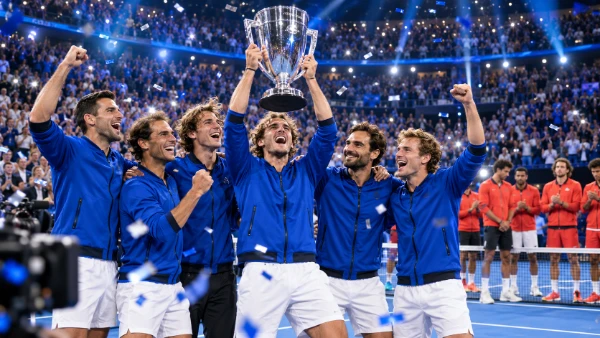
Team Europe reclaimed the Laver Cup on 27 September 2026, defeating Team World 13-5 at The O2 in London. The three-day tournament brought together 12 leading male tennis players from 25 to 27 September, with Alexander Zverev securing the decisive victory against American Learner Tien. Under captain Yannick Noah, the European side recovered from a difficult second day to claim its sixth title in the competition’s nine editions. Carlos Alcaraz, Casper Ruud, Jakub Mensik, Flavio Cobolli and Rafael Jodar also contributed important victories, while Team World, led by Andre Agassi, provided determined opposition. Despite the convincing final score, several matches were decided by extremely narrow margins. The London edition demonstrated how quickly fortunes can change in this unusual team competition and why doubles matches can prove just as important as individual performances.
Laver Cup 2026: London Hosts Europe’s Bid to Reclaim the Trophy
The ninth edition of the Laver Cup marked a return to a familiar setting. London’s O2 Arena had previously hosted the competition in 2022, when Roger Federer played the final match of his professional career and Team World captured its first title. Four years later, the same venue welcomed another contest between Europe and the rest of the world. The stakes were particularly significant for the European side, which had lost 15-9 in San Francisco in 2025. That defeat had given Team World its third title in four editions, creating an opportunity for captain Yannick Noah to restore Europe’s position in the competition. Playing in London offered the Europeans home support, although the previous visit had shown that this advantage did not guarantee success.
Both teams arrived with six players and experienced former champions in charge. Team Europe featured Spain’s Carlos Alcaraz and Rafael Jodar, Germany’s Alexander Zverev, Norway’s Casper Ruud, Italy’s Flavio Cobolli and Czech player Jakub Mensik. Noah was assisted by British tennis great Tim Henman. Team World included Americans Taylor Fritz, Brandon Nakashima and Learner Tien, Australian Alex de Minaur, Argentina’s Francisco Cerundolo and Kazakhstan’s Alexander Bublik. Andre Agassi captained the visiting side, supported by fellow former Grand Slam champion Patrick Rafter. The line-ups combined established competitors with younger players making their first Laver Cup appearances, giving both captains several options for singles and doubles.
The Laver Cup uses a scoring system that makes every day’s results important. Matches are worth one point on Friday, two on Saturday and three on Sunday, with the first team to reach 13 points winning the trophy. Both singles and doubles are played over a maximum of three sets, although a match tiebreak to 10 points replaces the deciding set when the first two sets are split. This arrangement means a team can recover from an early deficit, particularly during the final two days. The competition also differs from ordinary tennis tournaments because teammates sit together courtside, offer encouragement and receive guidance from their captains throughout matches. Individual results contribute directly to the collective score.
Friday’s Opening Matches Give Team Europe a 3-1 Lead
Casper Ruud gave Europe its first point on Friday, 25 September, after a closely contested opening encounter with Francisco Cerundolo. The Norwegian lost the first set in a tiebreak but responded to win 6-7(4), 6-4, 10-8. His ability to recover after falling behind proved valuable in a match lasting more than two hours. Team World answered through Brandon Nakashima, who defeated Jakub Mensik 6-1, 3-6, 10-7. Nakashima started strongly, encountered greater resistance in the second set and eventually secured victory in the match tiebreak. With the overall score level at 1-1, neither side had established a meaningful advantage, making the evening session especially important.
One of Friday’s most convincing performances came from 20-year-old Rafael Jodar. Making his Laver Cup debut, the Spaniard defeated Alexander Bublik 6-2, 6-3 in straight sets. Jodar handled the occasion confidently, converting four of nine break-point opportunities and winning 81 per cent of points played behind his first serve. His victory restored Europe’s lead at 2-1 and demonstrated that the team’s younger players could contribute alongside its established stars. Bublik, also appearing in the event for the first time, struggled to establish a consistent response. The result provided Noah with another encouraging sign that his squad possessed sufficient depth to compete across all three days.
Europe extended its advantage in the final match of the evening when Carlos Alcaraz partnered Mensik against Bublik and Taylor Fritz. The Spanish-Czech combination won 6-4, 6-4, securing the fourth and final point available on Friday. It was an important recovery for Mensik after his earlier singles defeat, while Alcaraz immediately contributed to the scoreboard without having played an individual match. Europe therefore finished the opening day ahead 3-1, having won three of the four encounters. Nevertheless, the result offered no certainty about the eventual winner. Europe had held the same opening-day advantage in San Francisco a year earlier, only for Team World to overturn it and lift the trophy.
Saturday’s Dramatic Matches Bring Team World Back into Contention
Saturday, 26 September, began with Team World facing a two-point deficit but knowing that each victory was now worth twice as much as on Friday. Learner Tien provided the first breakthrough against Flavio Cobolli. The American won the opening set before the Italian fought back, but Tien eventually prevailed 6-3, 2-6, 10-7. His victory brought the overall score level at 3-3 and gave Agassi’s team renewed confidence. The 20-year-old was making his Laver Cup debut and had already enjoyed significant progress on the professional tour during 2026. By defeating Cobolli, he demonstrated his ability to compete under the additional pressure of representing a team rather than playing solely for individual success.
Alex de Minaur then delivered another significant result by defeating Alexander Zverev 2-6, 7-6(5), 11-9. The German controlled the opening set, but his Australian opponent gradually turned the match around through determined defending and consistent pressure. De Minaur forced a second-set tiebreak and subsequently won a closely contested deciding match tiebreak. His victory gave Team World a 5-3 lead, completing an impressive recovery from Friday’s position. For Zverev, the defeat was particularly disappointing because he had been expected to provide valuable points for Europe. The result also increased the pressure on his teammates, who needed to prevent the visitors from carrying their momentum into the final day.
Carlos Alcaraz responded in the Saturday evening session with one of the tournament’s most important victories. Facing Taylor Fritz, who had helped Team World defeat Europe in 2025, the Spaniard won 6-3, 4-6, 13-11. After taking the opening set, Alcaraz lost the second and was pushed into a deciding match tiebreak that remained extremely close. Neither player could establish a comfortable advantage, but Alcaraz eventually secured the final two points to win. The result levelled the overall contest at 5-5 and prevented Team World from extending its lead. It also highlighted Alcaraz’s ability to perform in tense circumstances, delivering two essential points when Europe’s position had become increasingly uncertain.
Ruud and Zverev Turn the Contest Around in Saturday’s Doubles
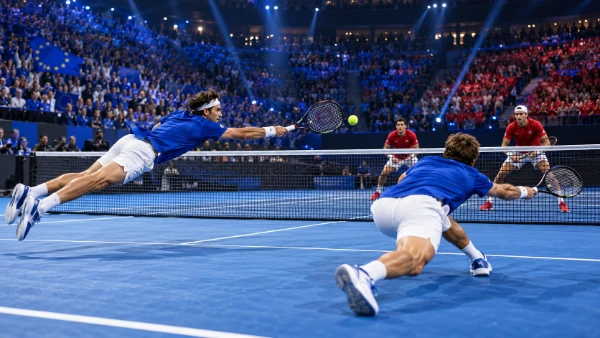
The final match on Saturday brought together Casper Ruud and Alexander Zverev against Alexander Bublik and Brandon Nakashima. Europe needed a victory to finish the day in front, while Team World had an opportunity to regain the advantage before Sunday’s higher-value matches. Ruud and Zverev won 6-4, 7-6(7), giving Europe two more points and establishing a 7-5 lead. The second set was considerably tighter than the first, but the European pair managed to finish the match without needing a deciding tiebreak. For Zverev, the doubles success provided an immediate response to his singles defeat against de Minaur and helped restore his confidence before the final day’s competition.
The doubles victory carried considerable strategic importance. At 7-5, Europe required only two wins on Sunday to reach the target of 13 points, while Team World would need three victories to overturn the deficit. Noah and Henman could therefore plan the remaining matches knowing that their side had a small but valuable advantage. Doubles selections were especially important because the strongest singles players could not necessarily be used in every encounter. The European coaching team needed to consider who was physically prepared, which combinations could work effectively together and how to preserve options should the contest extend beyond the opening Sunday matches.
Saturday also demonstrated how competitive Team World remained despite the change in momentum. Its three match victories across the first two days came from Nakashima, Tien and de Minaur, with the latter two collecting the four points available in Saturday’s daytime singles. Fritz narrowly missed another victory against Alcaraz, while Bublik and Nakashima pushed Europe’s doubles pair into a second-set tiebreak. These performances explain why the final 13-5 score does not fully reflect the resistance faced by Noah’s players. Several important points could easily have gone the other way. Europe’s advantage rested not on winning every close contest, but on securing the matches that mattered most at the end of Saturday.
Sunday’s Decisive Victories Secure the Laver Cup 2026 for Europe
Sunday, 27 September, opened with Europe leading 7-5 and the pressure increasing because every match now carried three points. Noah selected Flavio Cobolli and Jakub Mensik to face Alex de Minaur and Taylor Fritz in doubles. The decision proved successful, with the Italian-Czech partnership winning 7-5, 6-3. Although Cobolli and Mensik were not an established doubles team, they developed their understanding during the match and produced a convincing performance against two difficult opponents. For Cobolli, the victory was particularly satisfying after his singles defeat against Tien the previous day. Mensik also collected another doubles success, having already won alongside Alcaraz on Friday. Europe’s advantage increased to 10-5, leaving just one victory required.
Alexander Zverev entered the next singles match knowing that a win against Learner Tien would end the tournament. The American had already beaten Cobolli and offered considerable resistance, particularly during the opening set. Serving at 5-5, Tien recovered from 0-40 to hold serve and eventually forced a tiebreak. Zverev remained composed, winning it 7-3 before gaining the decisive advantage in the second set. He broke Tien’s serve to move ahead 4-2 and later completed a 7-6(3), 6-3 victory. The result secured three additional points for Europe and brought the overall score to 13-5. Having lost to de Minaur on Saturday, Zverev finished the weekend by delivering the tournament-winning performance.
Europe’s achievement was confirmed after the tenth match of the weekend, meaning the remaining scheduled encounters were unnecessary. Carlos Alcaraz had been due to face Alex de Minaur, while Rafael Jodar was listed to play Taylor Fritz, but neither singles match took place. The final score of 13-5 reflected the Laver Cup’s points system rather than the number of matches won. Europe finished with seven match victories against three for Team World, gaining six points from Sunday’s two contests alone. The combination of Cobolli and Mensik’s doubles success and Zverev’s singles victory prevented Agassi’s players from mounting another comeback. The trophy returned to Europe after the disappointment of San Francisco.
Europe’s Sixth Title, Zverev’s Records and London’s Lasting Impact
The victory carried particular significance for Alexander Zverev and Yannick Noah. Zverev became the player who had secured the decisive Laver Cup victory for Europe on four occasions, having previously done so in Chicago in 2018, Geneva in 2019 and Boston in 2021. London 2026 was his seventh appearance, and he had participated in all six of Europe’s tournament victories. By the end of the event, he had accumulated a record 26 Laver Cup points and achieved eight singles victories, another competition record. For Noah, the result represented his first title as captain in his second year leading the team. Alongside vice-captain Tim Henman, he had successfully guided Europe through a weekend in which several matches could have changed the outcome.
The London tournament was also successful in attracting spectators. Official Laver Cup figures recorded 74,336 attendees across five competition sessions at The O2, while another 5,350 people attended the open practice day. The free Fan Zone in Peninsula Square attracted 134,697 visits during the event, offering additional opportunities for supporters to follow matches and participate in tennis-related activities. The competition was broadcast to more than 220 territories, extending its audience well beyond the arena. London’s return as host city was especially notable because it became the first location to stage the Laver Cup twice. The event also continued its connection with local tennis development through activities supporting young people and the LTA Tennis Foundation.
Team Europe’s 2026 victory extended its overall lead in the Laver Cup series to six titles against Team World’s three. More importantly, it showed that Europe’s experienced players and younger competitors could work effectively together under pressure. Ruud’s opening success, Jodar’s impressive debut, Alcaraz’s narrow victory over Fritz and the contributions of Mensik and Cobolli all played important roles alongside Zverev’s decisive performance. Team World had opportunities to change the outcome, particularly on Saturday, but could not maintain its momentum during the final sessions. Attention now turns to the tenth Laver Cup, scheduled for 24-26 September 2027 at Intuit Dome in Inglewood, near Los Angeles. Team World will return to home territory seeking a response to London’s defeat, while Europe will defend the trophy it reclaimed in 2026.