
Medical Time-Outs in Tennis: How to Tell a Genuine Injury from a Tactical Pause
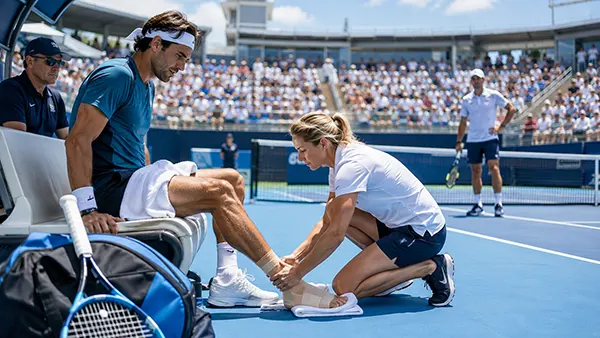
Medical time-outs are among the most debated interruptions in professional tennis because the same three-minute treatment period can have two very different effects: it can help a player deal with a genuine physical problem and, at the same time, interrupt an opponent who has built momentum. The difficulty for spectators is that these possibilities are not mutually exclusive. A player may be legitimately injured and still benefit tactically from the interruption. Under the rules used across professional tennis in 2026, the player does not simply declare a medical time-out and start resting. A qualified health professional must assess the condition, determine whether treatment is permitted and decide whether additional treatment time is required. This makes the medical assessment more important than the score, the timing of the request or the player’s visible reaction. Understanding that process is the most reliable way to separate reasonable suspicion from an unsupported accusation of gamesmanship.
What a Medical Time-Out Actually Means Under the 2026 Tennis Rules
A formal medical time-out, usually shortened to MTO, is not an unrestricted break requested at the player’s discretion. On the ATP Tour, a player who needs attention normally asks the Chair Umpire for the physiotherapist. The WTA follows a comparable process involving an approved primary health care provider, while Grand Slam regulations refer to a sports physiotherapist. The medical professional evaluates the player and decides whether the problem is a treatable medical condition. Only after that assessment can the Supervisor, Referee or Chair Umpire authorise the medical time-out according to the rules applicable to the event. This distinction is important because a player’s request for medical assistance does not automatically mean that an MTO will be granted.
The standard medical time-out on the ATP Tour, WTA Tour and at Grand Slam tournaments is limited to three minutes of treatment. Those three minutes do not necessarily begin when the player first asks for assistance or when play stops. The medical professional may first need time to reach the court, speak to the player, examine the affected area and determine what treatment is appropriate. The treatment clock starts when the medical professional is ready to begin treatment. Consequently, a television viewer may see an interruption lasting considerably longer than three minutes even though the actual MTO remains within the permitted treatment period. Waiting time and medical evaluation should therefore not automatically be counted as evidence that a player has received an unusually long break.
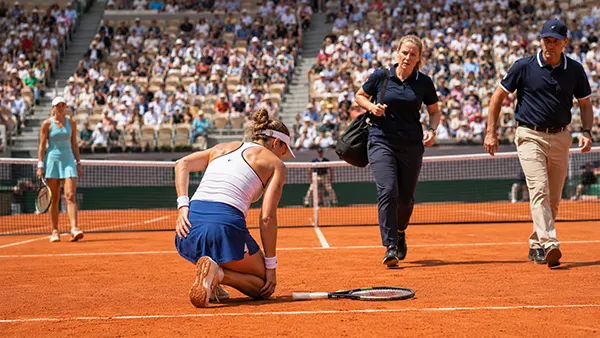
Medical attention is normally organised around a change of ends or set break when the condition does not require play to stop immediately. An acute problem is treated differently. If, for example, a player rolls an ankle while changing direction, experiences sudden severe pain or develops another condition requiring immediate attention, the medical professional may evaluate the player without waiting for the next scheduled break. A player is generally allowed one MTO for each distinct treatable medical condition. In exceptional circumstances, two consecutive MTOs may be authorised when the medical assessment identifies two separate acute and treatable problems. This means that the number of medical interruptions cannot always be judged simply by counting how many times a player has been visited by medical staff.
Which Physical Problems Can Qualify for Treatment?
The rules distinguish broadly between acute and non-acute conditions. An acute condition develops suddenly during the warm-up or match and requires prompt attention. A twisted ankle after a slide, a muscle strain occurring during a serve or an illness that suddenly affects the player’s ability to continue are typical situations in which immediate evaluation may be justified. A non-acute condition can develop more gradually or involve an existing problem that becomes worse during the match. In that situation, the player would normally continue until the next change of ends or set break before receiving an assessment. The central question is not simply whether the player had experienced discomfort before the match, but whether the condition has developed or become aggravated and whether available treatment can reasonably help within the permitted period.
Not every form of discomfort qualifies for an MTO. General fatigue is specifically treated as a non-treatable condition under the relevant professional rules. A player who is simply exhausted cannot obtain three minutes of medical treatment merely to recover physically. Muscle cramping also has specific restrictions. On the ATP Tour and at Grand Slams, cramping by itself does not qualify for a medical time-out and treatment is normally limited to the permitted changeovers or set breaks. WTA rules follow the same basic principle for cramping alone, although a medical professional may reach a different decision when cramping is one symptom of a wider illness or heat-related condition. This prevents an ordinary loss of physical endurance from being automatically converted into a medical break.
Other interruptions can also be mistaken for MTOs. Bleeding has its own procedures because play may have to remain stopped until the bleeding is controlled and any blood on the court has been dealt with safely. Extreme heat is another separate issue. The ATP introduced a new heat rule for the 2026 season that can provide a ten-minute cooling break after the second set in qualifying best-of-three singles conditions when the specified heat threshold has been reached. Such a cooling break applies under a separate rule and should not be described as a medical time-out. When evaluating a controversial interruption, the first task is therefore to establish what type of break actually occurred.
Why a Genuine Injury Can Look Like a Tactical Medical Time-Out
Suspicion usually begins with timing. A player loses several games in succession, faces a difficult service game or watches an opponent take control of the match and then asks for medical attention. From the outside, the sequence can look convenient. Yet the score provides no medical information. Tennis places repeated stress on muscles and joints through acceleration, braking, rotation, serving and rapid changes of direction. Some injuries occur after one obvious movement, while others become progressively harder to tolerate. A problem may therefore reach the point at which treatment is necessary at exactly the same time that the player’s performance deteriorates. In such a situation, the drop in performance and the request for treatment may have the same physical cause rather than the break being an attempt to explain poor play.
Visible movement is useful evidence, but it has limits. An ankle problem may be most noticeable when a player pushes laterally towards a wide ball but have little effect while walking between points. An abdominal problem may interfere much more with serving than with groundstrokes. Shoulder pain may become evident during high serves and overheads while normal forehand movement remains relatively comfortable. Back or hip problems can also fluctuate according to position, direction and intensity. For that reason, a player who walks normally to the chair and then receives treatment is not necessarily demonstrating that the injury was invented. Match movement places very different demands on the body from walking several metres at low speed.
Rapid improvement after treatment is another source of misunderstanding. The purpose of an MTO is precisely to provide treatment that may allow the player to continue. Taping an unstable area, adjusting support, applying appropriate hands-on treatment or dealing with a minor acute problem can change how comfortably an athlete moves. The player may also adapt tactically after the break by shortening points, taking fewer risks on certain movements or changing serving patterns. A competitor who appears significantly better immediately after an MTO has not therefore proved that the original problem was false. The more useful question is whether the player’s movement and shot selection remain consistent with the reported or treated physical limitation during the subsequent stages of the match.
Practical Signs That Make a Genuine Physical Problem More Likely
The strongest visible clue is usually a coherent sequence between the apparent cause of the problem and what happens afterwards. A player may land awkwardly, stop suddenly after changing direction, reach for a particular muscle or begin protecting one side of the body. In the following points, the same limitation may appear through shorter steps, weaker lateral pushes, reduced sliding, slower recovery towards the centre of the court or changes to the serve. These signs are more informative than a grimace because they relate directly to movement. Facial expressions can vary considerably between players, while a repeated mechanical limitation across different points is harder to separate from the physical demands of the match.
Consistency is equally important. If the right leg appears to be the problem, it is reasonable to watch movements that repeatedly load that leg rather than expecting every action to look impaired. A player may still strike a powerful forehand when the ball arrives within comfortable reach but struggle when forced to sprint wide and stop sharply. An injured server may retain considerable pace while reducing kick, body rotation or placement. Professional athletes are also accustomed to competing with discomfort, so the presence of several normal-looking points does not cancel evidence from the movements that actually stress the affected area. Injury assessment based only on isolated television clips can therefore produce misleading interpretations.
The interaction with the medical professional provides additional context, particularly when the assessment and treatment remain focused on a specific area. However, even this is not sufficient for a spectator to diagnose the problem. Some conditions are straightforward to see, such as bleeding or a visibly rolled ankle, whereas muscle strains, tendon irritation, abdominal pain, back problems and some illnesses may have few obvious external signs. Research into high-performance tennis continues to show that players experience both acute injuries and problems produced by repeated physical loading. The absence of dramatic symptoms is therefore weak evidence that no injury exists. The medical professional examining the player at close range has information that television viewers, commentators and opponents do not.
How Tactical Use Is Judged and Why It Is Difficult to Prove
A medical interruption can unquestionably affect the rhythm of a match. The opponent may have to sit down after winning several consecutive games, a server can lose the flow established during the previous service game and the atmosphere inside the stadium may change. That tactical effect does not establish tactical intent. The professional rules recognise the possibility of abuse and provide disciplinary mechanisms for it. ATP and Grand Slam regulations state that abuse of the medical rule can be dealt with under unsportsmanlike conduct provisions. WTA procedures also require a player to be truthful when claiming that an acute condition requires an immediate stop in play, with penalties possible when the rules are abused. Officials therefore have a framework for dealing with gamesmanship rather than simply accepting every interruption without scrutiny.
Proving deliberate misuse remains difficult because the crucial issue is medical rather than psychological. The Chair Umpire can observe when the request is made and whether the player follows the required procedure, but an umpire cannot reliably determine the seriousness of a strain, illness or joint problem merely from body language. That is why the medical professional performs the evaluation. If an authorised health care professional assesses the condition and finds that treatment is warranted, the timing of the request cannot by itself demonstrate dishonesty. A break taken at 1-5 and a break taken at 5-1 are medically judged by the same basic question: is there a treatable condition for which treatment is allowed?
Repeated appearances by medical staff can also create the impression that a player is repeatedly stopping the match, although different procedures may be involved. A player can receive an evaluation without ultimately receiving an MTO, and permitted treatment may also take place during certain regular changeovers or set breaks. A separate new condition can potentially justify its own medical time-out, while treatment connected with the same condition is subject to the applicable limits. In addition, medical attention for bleeding or treatment associated with specific heat-related procedures follows different provisions. A reliable assessment therefore requires more than counting the number of times a physiotherapist appears on court.
A Better Way to Assess a Controversial Medical Break
Instead of beginning with the score, it is more useful to reconstruct the sequence of events. The first question is whether there was an identifiable movement, physical change or developing symptom before the request. The second is whether the player’s subsequent movement remains reasonably consistent with the affected area. The third is what the officials and medical professional actually authorised. A request that follows a visible incident and is accompanied by a persistent movement limitation presents a stronger physical case than an interruption for which no change can be detected. Even then, however, the evidence remains observational rather than diagnostic unless official medical information becomes available.
It is also necessary to separate an MTO from every other legitimate interruption in tennis. Medical evaluation can occur before the formal three-minute treatment period. Treatment may sometimes be provided during an ordinary change of ends. Bleeding, heat procedures, equipment problems and authorised toilet or change-of-attire breaks operate under separate provisions. In 2026 this distinction is especially relevant because the ATP’s heat rule adds a formal cooling procedure to certain matches played in extreme conditions. Describing every long interruption as an injury time-out can make a normal application of the rules appear suspicious when a different regulation is actually being used.
The most accurate description of many disputed cases is therefore that a medically authorised break may also have produced a tactical benefit. Those two facts can exist together. A genuinely injured player can appreciate the chance to regroup while receiving treatment, just as an opponent can reasonably be frustrated by losing momentum. Neither reaction establishes that the medical condition was fabricated. Strong evidence of tactical abuse would require more than convenient timing: inconsistencies in the claimed problem, behaviour that conflicts repeatedly with the supposed limitation, an adverse decision from officials, disciplinary action or other reliable evidence would carry much more weight. Until such evidence exists, the distinction should remain between observable circumstances and proven gamesmanship rather than between a supposedly obvious real injury and an equally supposedly obvious fake one.